Sad lesson for others
The Waterloo man didn't fit the risk profile for cancer, but that didn't stop melanoma from taking his life. He was 26.
ANNE KELLY
|
|
|
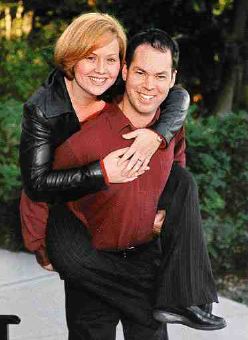
Corrie
Bridgman playfully lifts his wife, Alana, in this family photo. Alana,
like Corrie's parents, was concerned about a mole on his back long
before a diagnosis was made. Corrie died in June. |
|
|
|
|
|
DAVID BEBEE, GRAND RIVER LIFE
|
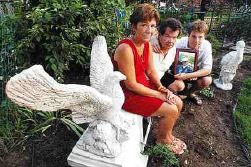
Cathy
and Doug Bridgman and their son Adam are creating a backyard garden to
honour Corrie Bridgman, 26, who died of cancer this summer. The memory
garden includes statues of an eagle, a bird he admired, and of a heron,
because of a bird that frequented his Waterloo neighbourhood. |
|
|
|
|
|
DAVID BEBEE, GRAND RIVER LIFE
|
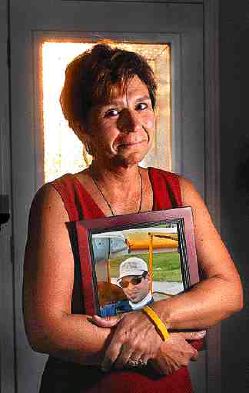
Cathy Bridgman of Kitchener holds a photo of her son, Corrie. |
|
(Aug 20, 2005)
I In his mid-20s,
with olive skin, few moles and no childhood sunburns, Corrie Bridgman
didn't fit the profile of someone at risk for melanoma -- the deadliest
of skin cancers.
He had no known family history of melanoma,
wasn't a sunbather and was a faithful sunscreen user, even reminding
his younger brother, Adam, to use it.
But in June of this year,
Corrie died of the disease, nearly two years after an initial
diagnosis, and nine months after a heart-breaking recurrence.
He was just 26.
In
2002, the Waterloo man's then-girlfriend, Alana Bower, was troubled by
a mole on his back that was slightly larger than a dime. She urged him
to talk to the family doctor he was seeing at that time.
The
doctor told him the mole was nothing to worry about, and refused
Alana's suggestion that Corrie be referred to her dermatologist. But
the mole grew darker, and when it started to bleed a year later, he
showed it to his doctor again. At Corrie's insistence, he was referred
to a dermatologist who removed the mole and determined it was malignant.
"I
thought something was wrong, but I didn't suspect melanoma," Corrie's
mother, Cathy Bridgman, said in an emotional interview at the Kitchener
home she shares with husband, Doug, and Adam.
"At first, I didn't
understand what melanoma was," added Corrie's sister, Lindsay, 25. "I
thought it was basal cell carcinoma (another form of skin cancer) which
is highly treatable."
Corrie's devastated loved ones believe he might still be alive if he'd been diagnosed earlier.
They decided to tell his story in hopes of educating others to be vigilant in having unusual moles checked.
"It
could have been caught," insists Alana, who married Corrie April 2,
after a long courtship. "My determatolotist said if it had been removed
at the time (in 2002), he probably would be OK.
"Just because you're young doesn't mean you can be cancer-free."
"We want to carry forward what Corrie would have wanted -- to at least save another life," his mother said.
She, too, had urged him to have the mole checked.
"Be
adamant if you think something is suspicious," Cathy advises. "I'll
never not go with my gut feeling. Get a second opinion if necessary.
"Be insistent, even if you have to pay for it. It's your life."
Corrie
was the second youngest patient Waterloo dermatologist Dr. Ken
Kobayashi had diagnosed with melanoma, though increasingly he is seeing
the disease among people in their 20s and 30s.
He was also the youngest of Kobayashi's patients to die of it.
Kobayashi was impressed by Corrie's kind heart and ambition. "I thought, this kid's going places."
He
wouldn't speculate on why the family doctor missed some of melanoma's
hallmarks. Those include a mole that changes in colour and border shape
and is more than five or six millimetres in diameter, which is
equivalent to the eraser on a pencil.
However, he emphasized that early detection is vital.
"This
is a cancer that is theoretically curable at an early stage," said
Kobayashi. "Because surgery is the treatment of choice for melanoma,
the earlier you cut it out, the better the outcome."
Kobayashi
said most melanomas grow larger in diameter, but some may only get a
little larger and a little darker and instead grow below the skin's
surface, where they can't be seen.
"Even experts like dermatologists can get fooled," said Kobayashi. "You can miss a melanoma."
In
Corrie's case, even after the mole was excised in September 2003,
Kobayashi said his level of risk was considered intermediate, meaning
that he had a 10 to 15 per chance of the melanoma spreading to other
parts of his body over five years.
Further surgery and tests after the removal found the cancer had not spread.
But
melanoma has a tendency to resurface in other organs, and when that
happened to Corrie, a year later, rounds of chemotherapy couldn't stop
it.
Corrie had everything going for him when he was stricken.
With
his math degree from the University of Waterloo, the computer whiz
landed a good job as a systems analyst with Guelph Hydro and had bought
a lovely home in west Waterloo not long before his diagnosis.
He
was saving money to achieve one of his lifelong dreams -- to own a
single-engine plane by the time he was 30, a purchase he and Adam
planned to make.
Corrie was an active air cadet from the age of
12, learning to fly glider and four-seater planes and mentoring other
cadets, including Adam. He also loved to cross-country ski with his
father.
He continued to feel well after the mole was removed. But
eight months later, in April 2004, he started having headaches, and in
July 2004, he began to have severe leg and back pain. Then he
discovered a cyst on the back of his neck and one in his armpit.
The
cysts were removed and he underwent a series of tests. Early last
September, he received the crushing news that there were masses in his
lungs, abdomen and liver.
That same night he experienced numbness
and drooling. Taken to Grand River Hospital's emergency department, he
had a CT (computed tomography) scan which showed two tumours in his
brain (a subsequent scan using with contrast dye showed four).
Corrie
was admitted to hospital, where he started radiation treatment Sept. 7
to try to shrink the tumours. He was also given a drug to reduce
swelling in his brain, which relieved his symptoms.
He wouldn't
accept the grim news from a Kitchener oncologist that nothing more
could be done. Instead, he went to his surgeon who referred him to Dr.
David Hogg, a Toronto oncologist and melanoma expert.
Hogg
started him on chemotherapy treatments, which ran ran from Sept. 21
until early May of this year. During the treatments, which were
successful in shrinking some of the tumours and relieving his symptoms,
Corrie continued to work.
He refused to let his life stand still.
He and Alana, an elementary school teacher, were engaged last October
and initially were going to put off the wedding. But, said Alana,
Corrie wanted children and so, on April 2, they married.
"He
wanted to have hope, something to strive for," Alana said. "We thought
it would give him that much more strength. I didn't think I would be
helping him at all if I would have abandoned him."
But days after
the nuptials, the leg pain returned. He started vomiting and lost close
to 50 pounds from his six-foot-two-inch frame.
Doctors thought
the bone in his leg might be disintegrating and weren't sure what to
do. He was placed on strong painkillers and could get relief only by
lying down.
On May 26, while at home, he took a turn for the
worse. He couldn't get out of bed and became disoriented. He was rushed
by ambulance to Grand River Hospital where a CT scan of his brain
showed 16 tumours, his mother said.
Doctors suggested radiation
to relieve the leg pain. But there was a chance it could harm his
already-impaired cognitive ability.
After two treatments, he was
no longer able to talk and the radiation was discontinued. Corrie
remained in hospital and experienced a brief period of lucidity on June
9, three days before his death, while his father, Doug, was visiting.
"We
were recalling pleasant experiences, different trips we took together,
working on his basement together, working on our shed together.
"I asked him, are you going to come out (of hospital) tomorrow? He said, 'No.'
"Are you ever going to come out? He said, 'No.'
"At that point, we were just waiting for the end," Doug said.
Hundreds attended Corrie's funeral visitation, including young air cadets who spoke of how he inspired them.
Adam was one of those who benefited from his leadership.
"He
is the reason I stuck with air cadets, while I got my gliding and
flying scholarships and the reason I am who I am," the shy 19-year-old
wrote in his tribute.
"Corrie was always an idol to me," added Lindsay, who moved into Corrie's home while attending the University of Waterloo.
They
shared a love of music and she has fond memories of the time he took
her to a U2 concert. Another brother, Mike, 21, also lives with Alana
and Lindsay.
Alana said she was amazed by her husband's inner strength during his battle with cancer.
"He was a fighter to the bitter end."
"He was very disciplined, very strong, very private," added his mother.
As a lasting tribute to Corrie, his parents are creating a memory garden in their backyard.
It
will include concrete statues of an eagle, which is a bird Corrie
admired, and a heron, in memory of one that frequented his Waterloo
neighbourhood.
It is a place of comfort in which his family can try to heal.
His
parents wish they'd pushed harder for earlier detection or even more
aggressive followup tests after the initial diagnosis, to check for
signs of spread.
"We're at the point now of anger, that we allowed this to happen," said Doug.
Cathy sums up their feelings in a near-whisper.
"We just hurt," she said.
akelly@therecord.com
MELANOMA FACTS
In
Canada this year, it's expected 4,000 to 5,000 new cases of melanoma
will be diagnosed and about 20 per cent will ultimately prove fatal.
Canadians
have a one per cent risk of developing melanoma over their lifetime,
but the incidence is rising steadily -- the steepest rise in any type
of cancer.
Sun damage is a significant risk factor, as is fair skin, and an abundance of moles, especially atypical ones.
People
with a family history are at a very high risk of melanoma. Those with a
genetic mutation have a 60 to 80 per cent chance over their lifetime of
developing melanoma.
Melanomas can occur in areas of the body that are difficult to see, such as the back or in a crease, like the groin area.
Moles may not change very rapidly.
Never feel embarassed about reporting a skin concern to your family doctor.
Sources: Dr. David Hogg, oncologist. and Dr. Ken Kobayashi, dermatologist
PREVENTION TIPS
The Canadian Dermatology Association recommends these sun tips:
Reduce
sun exposure between 11 a.m. and 4 p.m., when the sun's rays are at
their strongest. Seek shade or create your own shade. Be prepared for
places that don't have shade by taking along an umbrella.
Slip on
clothing to cover your arms and legs, protecting skin from the sun.
Choose clothing that is loose-fitting, tightly woven and lightweight.
Wear
a wide-brimmed hat that covers your head, face, ears and neck. Most
skin cancers occur on the face and neck, so this area needs extra
protection. Baseball caps do not give you enough protection.
Wear
sunscreen with SPF (sun protection factor) 15 or higher. Look for SPF
30 if you work outdoors or if you will be outside for most of the day.
And
look for ''broad spectrum'' on the label. This means that the sunscreen
offers protection against two types of ultraviolet rays, UVA and UVB.
Apply
sunscreen generously 20 minutes before outdoor activities. Reapply
often -- at least every two hours -- and after swimming or exercise
that makes you perspire.
Keep babies out of the direct sun. Children under one year need extra protection because their skin is very sensitive.
Tanning salons and sunlamps are not a safe way to tan. No tan is a safe tan-- a tan is evidence of sun damage.
THE A B C DS OF SUSPICIOUS MOLES
It's
important to have abnormal or changing moles checked by a doctor as
soon as possible. The Canadian Cancer Society recommends people
remember the ABCDs of melanoma.
Asymmetry: One half is unlike the other half.
Border irregular: Scalloped or poorly defined border.
Colour varies: From area to area with shades of tan, brown, black and sometimes white red, or blue.
Diameter: Larger than six millimetres (the size of a pencil eraser).


 View newspaper page (PDF)
 Printer friendly format